


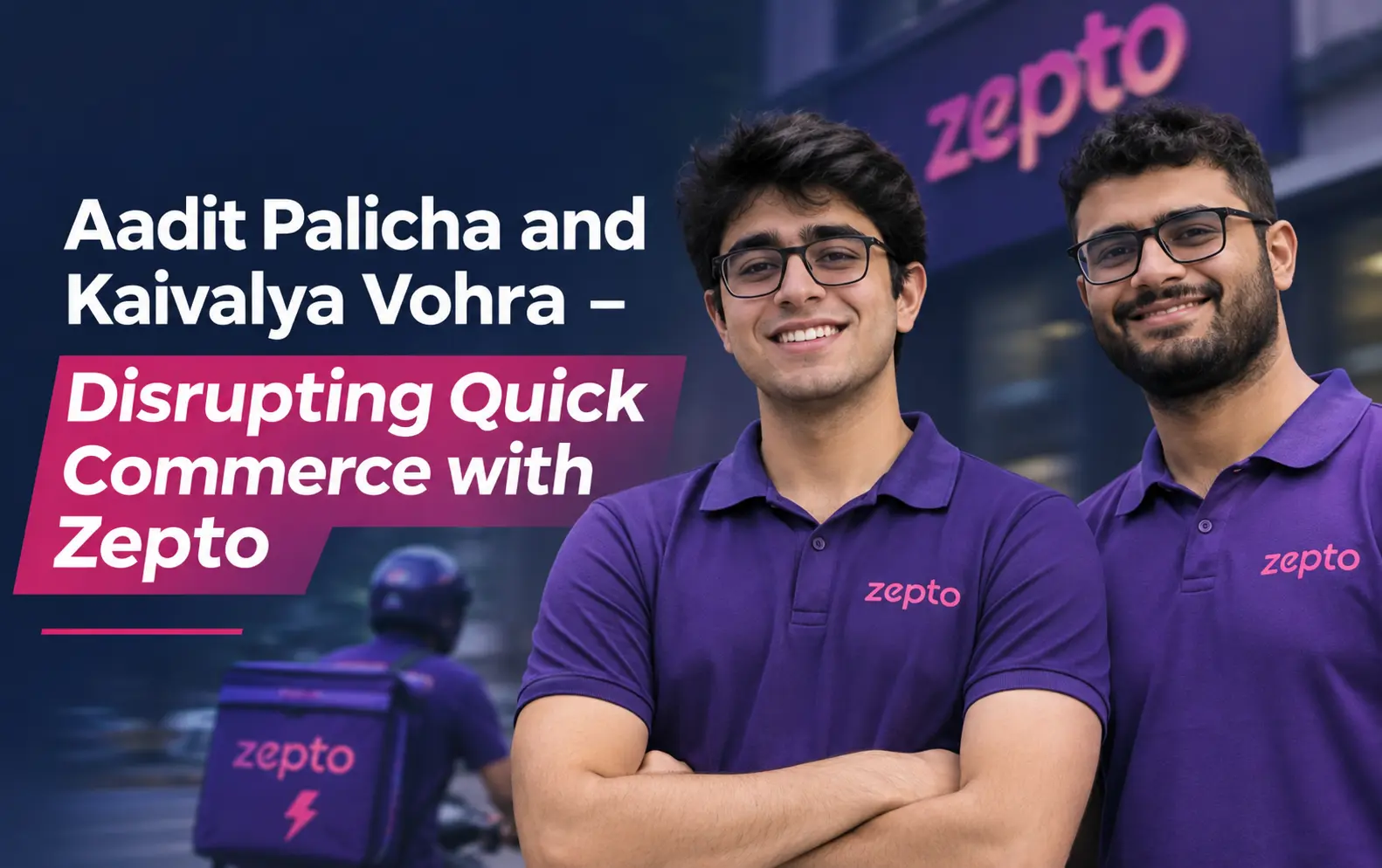
Two childhood friends from Mumbai set out to achieve the goal of delivering groceries within ten minutes, an ambitious promise considered impossible by veteran retailers. Six years later, Zepto, their brainchild, has over a thousand dark stores, about 48 million users per year, competing against Blinkit and Swiggy Instamart. Nevertheless, they have been struggling financially, and till date, are yet to go public. In this essay, Zepto’s story will be critically analyzed with focus on the founders’ experiences, expertise, established authority, and unresolved trust issues.
THE EXPERIENCE: A LOCKDOWN, A WHATSAPP GROUP AND A DROPPED STANFORD PLACE
Zepto started in 2020, when both Aadit Palicha and Kaivalya Vohra were 17 and 18 respectively. Both were selected to participate in the computer science course offered by Stanford. They participated in orientation from their computer screens, but during the pandemic, they came back to India to experiment with grocery delivery services. Aadit is a native of Mumbai. Kaivalya was born in Bengaluru and has grown up in Dubai.
The first business they started was called KiranaKart. This name was inspired by kirana stores found in neighborhoods across India. At the start, the idea was quite rudimentary and normal, just collecting grocery orders and delivering them. However, what set their company apart was something they noticed from real-life experiences. When they were under lockdown, customers did not object to paying for the convenience offered. However, waiting was intolerable.
They did this in 2021, and since then, the company is known as Zepto. And they have been running as founders even before some of their contemporaries even completed their degrees. This was a factor that played into the advantages that they had but also the questions raised against them. They had no corporate history at all, but lots of agility, which also meant that they had no experience in the retail sector either.
THE EXPERTISE: WHY TEN MINUTES IS AN ENGINEERING PROBLEM
The ten-minute promise is frequently referred to as a marketing slogan. However, it is more of an operational and software issue, and this is when the technical expertise of the founders becomes relevant.
Zepto’s business model hinges on dark stores – small distribution centers which are not open to the public and which are located right in the center of densely populated neighborhoods such that a rider should be able to deliver to almost any address within two kilometers. As per the filing of the company, the distance travelled per delivery reduced from 2.05 km in fiscal 2024 to 1.83 km in March 2026.
There are three kinds of know-how that underlie the model.
Demand forecasting. The dark store stores tens of thousands of different goods in a few thousand square feet. If you stock up incorrectly, the shelf space will be wasted; you won’t have enough of the correct goods to fulfill the ten-minute promise. Zepto’s algorithms forecast the demand for each individual store on the product level.
Store-level operations. The pickers and packers are trained to put together the order in one or two minutes. The store layout, the shelf positioning, and packing processes are optimized to do that as fast as possible, similar to how kitchens are designed.
Densification. Instead of trying to rush to operate in hundreds of cities, Zepto focused on filling the cities where it was already operating with more stores. More stores result in shorter travel times, faster deliveries, and more orders per store, which means spreading fixed costs.
It seems that these numbers from the filings show that the model worked in terms of throughput. Orders per store per day increased from 1,425 to 2,140 in one year, while Instamart processed almost half of the orders, despite having the same number of stores.
THE AUTHORITY: CAPITAL, SCALE AND A PLACE AT THE TOP TABLE
Business authority is determined both by whom you know and by the figures. Zepto has earned its place as one of the top consumer internet companies in India based on both criteria.
Investments speak for themselves. In 2023, the company closed on $200 million at a valuation of $1.4 billion, thus becoming the company whose founders were the youngest to bring their Indian startup to the unicorn level. In June 2024, it attracted $665 million at a valuation of $3.6 billion.
A few months later, the company received $340 million at a valuation of $5 billion. In October 2025, another round worth $450 million brought the company’s valuation to roughly $7 billion. The investors in all those rounds included General Catalyst, Nexus Venture Partners, Lightspeed, StepStone and Glade Brook, as well as increasingly more Indian domestic investment funds and family offices.
And scale came next. In its financial year 2026, Zepto reported operational revenue of ₹22,624 crore, double of what it had been in the last fiscal year. As of 31 March 2026, it had set up 1,139 dark stores, processed an average of about 17.5 lakh orders daily, and had 48 million yearly transacting users, which was slightly higher than the previous 38 million. Apart from groceries, it has ventured into other categories like electronics, cafe, and retail media that allow for brands to advertise in the app.
A note of context regarding the competition: Blinkit by Eternal (formerly Zomato) had around 2,243 stores in March 2026, far more than Zepto’s 1,139. And Instamart had 1,143. Zepto is not the largest store operator but claims to be the most efficient one.
THE TRUSTWORTHINESS: LOSSES, A DELAYED IPO AND THE QUESTIONS THAT REMAIN
An all-flavoring profile cannot be trusted. Here is the flip side of the coin.
The company Zepto is operating at a loss. Its fiscal 2026 net loss expanded by around 26 per cent to ₹5,905 crore despite revenues doubling. There have been reported cumulative losses for Zepto since its launch. The analysts have argued that quick commerce is all about land grab where investing heavily on stores and marketing would eventually pay off when contribution margins become positive.
Zepto has stated that many single dark stores become profitable but the company itself is not there yet.
Some other risks are present in the disclosures of the company itself. These include labor strikes and disruptions, a heavy dependency on the dark store ecosystem, volatile marketing expenses, and stiff competition that can impact pricing and margins. More than one-third of the total number of its stores are managed through franchise partnerships.
However, the story behind the IPO was less neat than earlier headlines had indicated. Zepto submitted confidential papers in December 2025 and filed an updated draft prospectus in June 2026 in which it proposed a new issue worth ₹8,010 crore and it obtained regulatory approval from SEBI in May 2026. As per the plan, about ₹1,629 crore will be used for adding new dark stores, ₹1,735 crore for rentals of existing stores, and about ₹1,325 crore for technology and cloud infrastructure. However, up to October 2026, there was no announcement regarding the opening date or price band. In mid-2026, the company postponed its listing and raised about ₹1,000 crore in a pre-IPO round at a valuation of around $4.5 billion, below the $7 billion mark from late 2025. Readers may take these figures as reported figures and refer to the company’s filings for current information.
None of this means the Zepto story is a failure. It only means the story is still incomplete, and the next chapter, whether the economics work out and whether public markets fund the growth, will tell more than any of the earlier ones.
WHAT FOUNDERS AND ENTREPRENEURS CAN LEARN
Beneath the valuation noise are some key takeaways.
Solve a pain point problem. Palicha and Vohra were not the first to think of grocery delivery service. They just identified waiting as the problem and created the entire company to solve the same.
Work fast, but be systematic. It was their speed which put them in the limelight, but the sustainable advantage comes from their forecast modeling, store design and logistics system which is the underlying technology of their promise.
Be realistic about the economics of the model. Sustained growth through losses is only a strength if the company ultimately turns out to be profitable. Those founders who monitor unit economics early are more prepared than others when investors ask questions.
Pick up the capital wisely. Looking for domestic investors along with foreign funds was a well-thought strategy.
THE VERDICT
Palicha and Vohra took an initial lockdown concept and fashioned it into one of India’s hottest consumer businesses. The youthfulness and naivety of the founders enabled them to move fast and come up with new ideas. Their technical expertise is reflected in their store design and technological capabilities. Their funding and operating capabilities make them credible in this field. And the many unknowns with respect to profitability, competition, and IPO ensure that this story stays true.
It will depend on how successful this venture will become whether it turns out to be a great example or cautionary tale. From an academic standpoint, those looking at entrepreneurship in India will find this story interesting to analyze.