


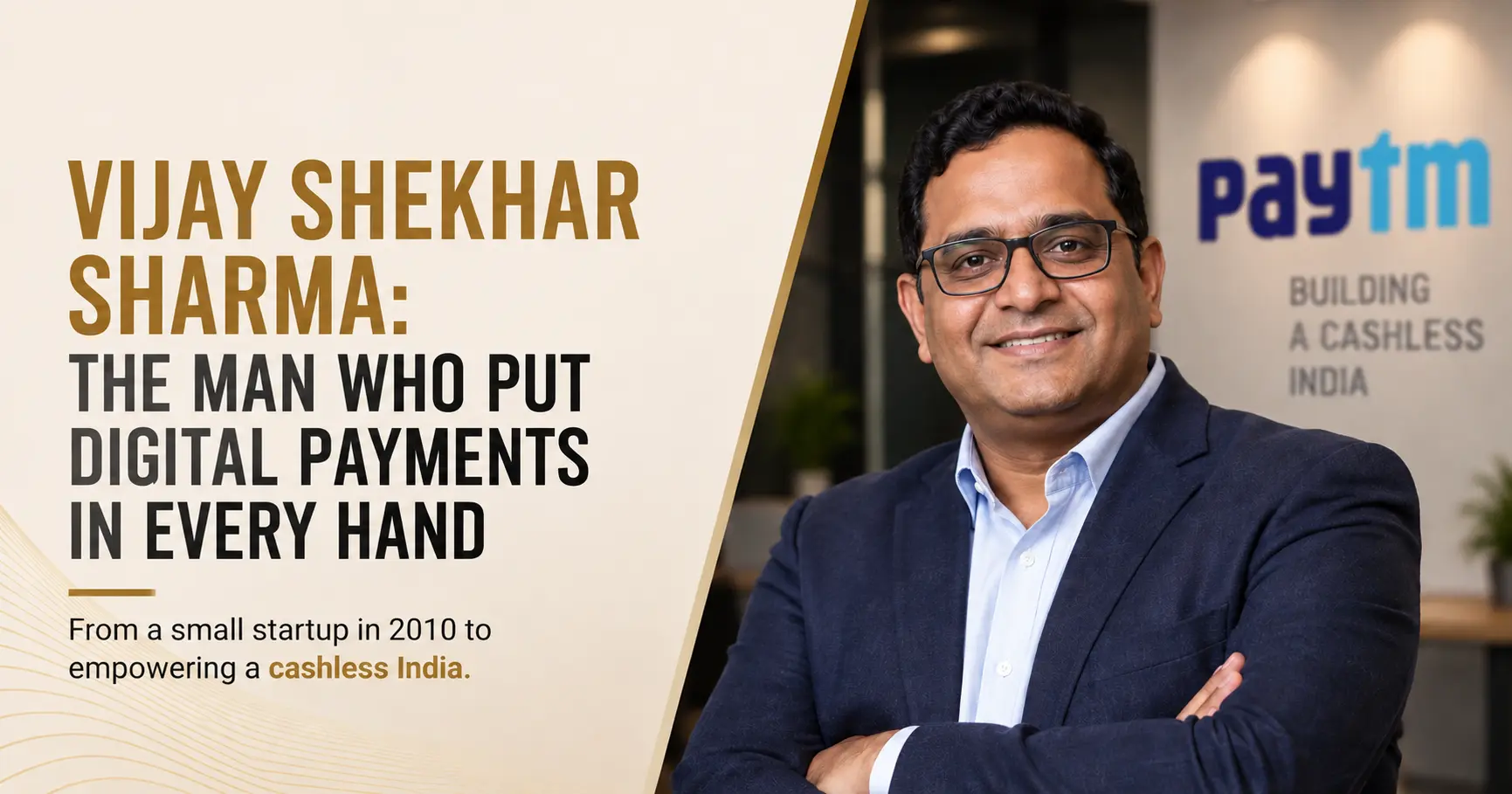
It used to be common practice to pay your autorickshaw driver in India in coins, and your shop owner in queues outside ATMs. It took the single-minded focus of one entrepreneur on mobile technology to change all that. The story of Vijay Shekhar Sharma can be best described as a series of bold bets he made one on the internet in the 90s, another on mobile content in the early 2000s, and finally, a bet on the wallet app that came to be known as India’s biggest fintech brand. This is the story of Vijay Shekhar Sharma- of a small-town school teacher’s son from Uttar Pradesh who created Paytm, had the biggest IPO rollercoaster ride in India, but still held on to his faith in digital cash being as easy as texting.
Early Life and Education
Vijay Shekhar Sharma was born on 7th June 1978 in Aligarh, Uttar Pradesh and is the third of four siblings. The father Sulom Prakash Sharma taught in school whereas Asha Sharma is his mother and runs their home. He was brought up in Harduaganj, a small town near Aligarh, within a Hindi-medium schooling which did not expose him much to the English language, a problem which was to haunt him for his entire academic life.
At fifteen, while others were probably busy with school, he joined Delhi College of Engineering (now called Delhi Technological University) and started studying electronics and communication. The transition from a small town and a Hindi environment to English-dominated engineering education in the capital was rather shocking.
His classmates were used to learning in English texts from English schools and thus outshone in every discussion in class. Instead of being afraid, Vijay Shekhar focused more on computers and the Internet which was relatively new in India back then and taught himself through programming languages. He completed his B.Tech at the age of nineteen.
First Steps in Entrepreneurship
That itch found its release during his college days. In 1997, in a country where the internet was barely a couple of years old, Sharma created indiasite.net, a content site based on the belief that there should be Indian content for Indian internet users. Not a glamorous endeavor by today’s standards, this venture proved to be successful enough for him to sell it off two years later for nearly a million dollars, quite an amazing achievement for a young entrepreneur of that time.
Rather than relaxing after that success, he kept at it. He started One97 Communications in 2000, which provided mobile content such as news, cricket scores, ringtones, jokes, and examination results to India’s early mobile customers, a time when most Indians were using their first mobile phones without smart features to access the internet. One97 was a mundane affair, but it taught him a lesson that he would find invaluable later: the behavior of Indian consumers in using mobile phones. This experience in understanding mobile-first is what links his first venture to his most famous venture.
How Paytm Was Started
By the year 2010, Sharma had been in One97 for about a decade, witnessing people’s behavior change with respect to mobile recharges and bill payments moving more and more toward online platforms. From there emerged Paytm which stands for “Pay Through Mobile” and was first started as a pre-paid mobile and DTH recharge service. A humble beginning indeed with no banks involved and no huge amount being invested in marketing.
This concept took some time to grow before it exploded because what Sharma had created at that time was the foundation of digital payments infrastructure as well as consumer trust, both of which became very important when digital payments became a reality in India.
Bringing Digital Payments to India
This opportunity came in the month of November 2016, when the Indian Government announced the withdrawal of large denomination notes. Due to demonetization, there was a sudden vacuum of cash across the nation and Paytm, which was already built, ready to be used in smaller transactions, was one of those few platforms that could take the impact. There was an influx in download of the app, many merchants joined and Paytm’s wallet became a true replacement to cash in vegetable markets, street side shops and even in cabs all over India.
It might seem that demonetization was the only reason behind the success of Paytm but there are many other factors as well. It is due to the efforts of Sharma that Paytm became the perfect platform for making cashless transactions at the time of demonetization. He had already developed the system of QR codes for merchants, wallet facility and a brand name in India. This event only acted as an accelerant rather than being a spark.
Paytm’s Growth and Expansion
Diversification soon followed. Paytm diversified not only into e-commerce but movie and travel tickets, payments bank, wealth management, insurance distribution, and merchant lending. Warren Buffett’s Berkshire Hathaway injected about $300 million into the company in August 2018, an endorsement coming from a conservative investor and showing that Paytm had now reached the point of institutional credibility.
One97 Communications became public in November 2021 in an IPO worth approximately $2.5 billion and a valuation around $19 billion, making it the biggest ever IPO in India. Paytm is still India’s biggest publicly traded fintech platform as of 2026, with more than 300 million users across various financial services, an accomplishment not equaled by many other Indian entrepreneurs born in Sharma’s generation.
Challenges and Major Turning Points
Paytm founder’s story has always had an element of turbulence in it, but this time it is not just the founder who paid the price for Paytm’s problems as the stock price fell considerably in the days following the listing. This time the problem for the company was even more pronounced as in 2024 the Reserve Bank of India (RBI) prevented the Payments Bank of India from taking any deposits and wound down most of its operations due to its compliance failure. Sharma resigned from the board of Payments Bank to distance Paytm’s main operations from this issue and move forward via partner banks.
For many other firms such problems would spell the end of their existence. Paytm managed to recover from the issue via switching its UPI service to partner banks, improving compliance measures and concentrating on payments and lending to merchants. It affected the founder’s net worth as it became tied with the performance of the One97 Communications stock- it amounted to ₹6,594 crore (less than a billion dollars) in 2026.
Vijay Shekhar Sharma’s Leadership Style
The colleagues and observers following Sharma’s career as an entrepreneur typically agree about the characteristics of Sharma: restlessness, being willing to back untested mobile behavior even when it is not yet evident, and the unusual directness and hands-on approach typical of a founder managing a firm such as Paytm.
Moreover, he maintains visibility even in times of trouble instead of hiding from them. During the 2024 banking crisis, Sharma interacted directly with the regulators and media rather than leaving the issue to be sorted out only by spokespeople.
Additionally, Sharma has developed the practice of sharing his beliefs outside the boundaries of Paytm. So far, Sharma has personally backed more than twenty startups in areas such as mobility, healthtech, edtech, and even space technologies, all indications that the founder knows how to read the future wave of Indian entrepreneurship.
Lessons from His Journey
There are some consistent takeaways that emerge from the story of Sharma’s journey thus far. First, solve for the lack of infrastructure, not the cool feature- Paytm succeeded by doing something boring and unexciting (sending money efficiently) way before it became popular. Second, success should not be an end in itself, Sharma had made enough money off his previous venture selling out at twenty-one, but that did not stop him from embarking on an even tougher and less glamorous one right away. Third, adaptability is more important than avoiding failure in the first place, the regulatory action of 2024 would have killed Paytm’s core business, and it survived more due to its agility than anything else.
If you enjoyed learning about Shiv Nadar’s journey, discover the stories of other top Indian business leaders and entrepreneurs who turned their vision into remarkable success.
Future Vision
And yet again, Sharma continues to define the future of Paytm in the context of expanding financial inclusion, through merchant lending, insurance, and wealth products for Indian users who are still unbanked, while at the same time defending its core payment operations against the rising threats from competitors born out of the UPI ecosystem. The key question remains whether Sharma is able to turn the huge user base of Paytm into profitability.
Conclusion
The biography of Vijay Shekhar Sharma does not conform to the neat tale of “rags to riches”; rather, it is the story of an entrepreneur whose decade-long building of humdrum infrastructure came only when the time was right, who got catapulted to national importance due to a policy shock that had never been seen before in the history of this country, and then had to work on restoring the trust with the regulators in the wake of an almost existential crisis.
ReciteYou topical connection
Stories such as Shiv Nadar’s demonstrate why studying the journeys of extraordinary entrepreneurs and business leaders can be so valuable. Their experiences reveal the challenges, decisions and turning points that shape long-term success. → inspiring entrepreneurs and business leader