
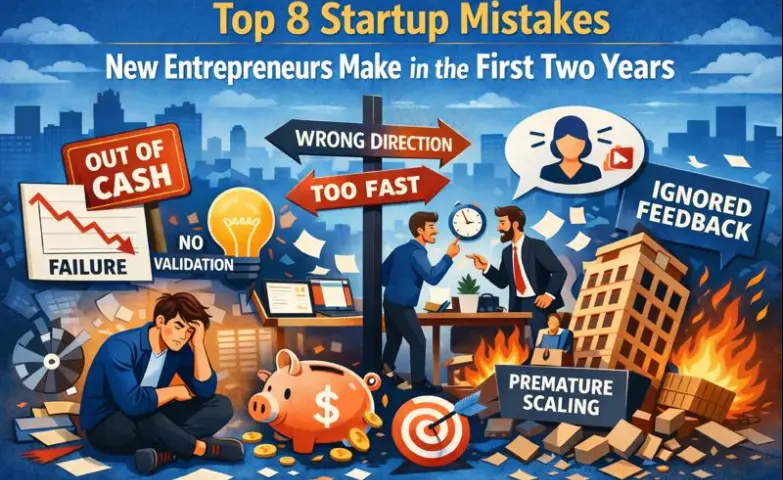
From Startup Mistakes To The Journey of innovation, freedom, and rapid success
Journey of innovation, freedom, and rapid success is how we often describe the process of building a startup. Headlines of young founders dominating the market, overnight funding rounds and stories of unicorns inspire thousands to take the leap every year. However, behind these romanticised versions of success stories lies a harsh reality. 90% of startups fail and get closed.
Experienced entrepreneurs often say ‘The early phase of a startup is fragile’. Decisions which are applied during this period can either lay a strong foundation or plant the seeds of failure.
We often come across a quote that says ‘When a founder is driven by passion, the startup thrives’, but most startups do not fail because founders lack passion or intelligence, they fail because of avoidable mistakes that compound over time.
Major Mistakes made by New Entrepreneurs
Building in a vacuum without market validation
Building in a vacuum without market validation: Falling in love with one’s own solution is the most seductive trap for founders. You picture something, get excited and immediately start building. Months pass as you perfect the product, add features, and refine the user experience. In the process you forget you’re not building a product, you’re solving a problem that people actually have and are willing to pay to solve.
To prevent such mistakes, Validate the idea with real users before full-scale development or build a Minimum Viable Product (MVP) and ask customers what problem they face, not whether they like your solution.
Poor cash flow
Poor cash flow: The major reason for startup failure is running out of money. Many founders ignore basic financial discipline and focus heavily on growth and branding. In the first two years expenses are constant and revenue is usually unpredictable. Spending heavily on marketing without results, hiring too fast or assuming funding will always be available can quickly drain capital.
Mixing personal and business finances, overspending before revenue stability, no clear budgeting and assuming investors will “save” the business are some common financial mistakes.
Experienced entrepreneurs often speak to track monthly burn rate carefully, prioritise essential spending and delay unnecessary hires and expenses.
Ignoring customer feedback
Ignoring customer feedback: Some startups build features based on internal assumptions and ignore feedback that doesn’t match their vision. This results in products that are technically impressive but practically unusable.
Treating negative feedback as a growth tool and not criticism is one of the key factors for building a successful business.
Weak marketing strategy
Weak marketing strategy: Inconsistent brand messaging, no clear target audience and relying only on social media without strategy are common marketing mistakes.
To avoid it define these mistakes define your ideal customer clearly, build a simple but consistent brand identity and start content marketing early (blogs, social media, newsletters).
Lack of clear vision
Lack of clear vision: In the beginning, startups often change direction frequently. While flexibility is important, lack of clarity often leads to internal and external confusion. Motivation weakens and productivity drops when teams fail to understand the long-term vision.
Vision matters because it serves as a pathway to build investor confidence. It aligns team efforts and strengthens brand identity.
To avoid problems, clearly define mission, vision, and goals. Communicate regularly with the team and ensure daily decisions align with long-term objectives.
Scaling too fast
Scaling too fast: While we romanticise rapid growth, we overlook that premature scaling is one of the most dangerous mistakes startups make. New entrepreneurs often fail to realise that expanding operations, entering new markets, or increasing team size before achieving stability can collapse the entire structure.
Expanding before understanding core customers, increasing costs without matching revenue and operational chaos are few signs of premature scaling.
To avoid it, owners should focus on retention before expansion. Firstly, strengthen internal systems and scale only when growth is repeatable and sustainable. Growth should be intentional, unplanned growth results in stagnation.
Neglecting market changes
Neglecting market changes: Markets evolve quickly. Preferences of customers change, new competitors emerge and technologies advance. New establishments that refuse to make changes and adapt to a new environment often become irrelevant.
To stay adaptable, monitor market trends, be open to pivots and use AI or data to guide decisions. Flexibility is survival, not weakness.
Weak founder – co-founder relationship
Weak founder – co-founder relationship: Reports reveal many startups fail not because of the market, but because founders cannot work together. Within the first two years differences in expectations, workload, equity, or decision-making commonly appear.
Personal conflicts affecting business decisions, unequal commitment and lack of role clarity are some common issues.
To avoid it, one should discuss expectations early, maintain open communication and resolve conflict professionally. One of the biggest assets a startup can have is a strong founding team.
Share your views on the mistakes new owners should avoid with Recite You and gain an opportunity to be featured.