


Are you a wanderer who wants to explore lesser known destinations that holds exceptional beauty? In a World where travel is measured by Instagram checklist, a small movement is developing where people value preservation over promotion and connection over consumption.
Many people think eco friendly destination is only about green hotels and reusable bottles, but when we look at it more deeply it is about landscapes and communities that have lived sustainably long before the word “eco-tourism” existed.
India consist of vast culture and ecological diversity, it hides some of its most meaningful green travel experiences in places rarely spoken about.
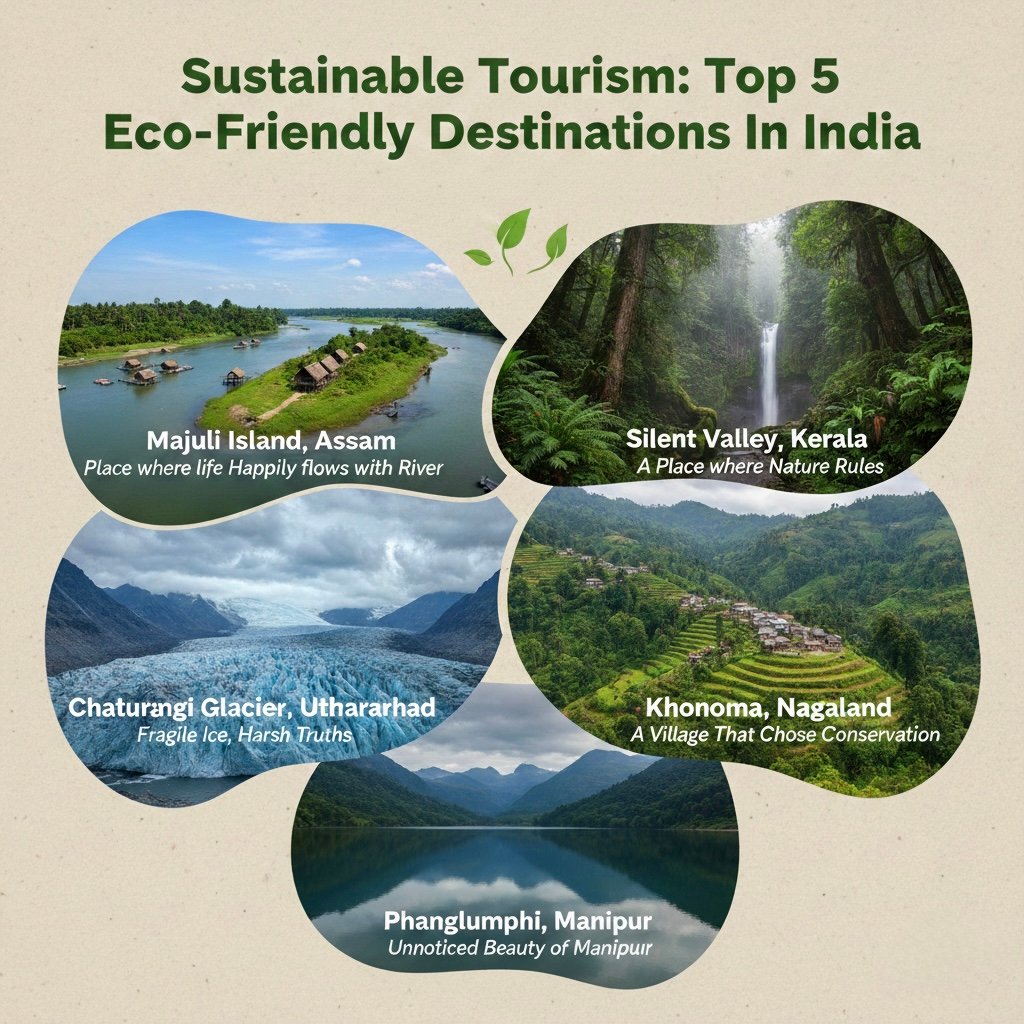
Majuli Island, Assam – Place where life Happily flows with River
Majuli is one of India’s most culturally rich yet environmentally fragile landscapes. Nestled in the mighty Brahmaputra River, it is the world’s largest river island. Majuli is more than a geographical marvel, travellers mention it is a living example of how human life can adapt to nature rather than control it.
Declared as a district in 2016, Majuli is a home to the Neo-Vaishnavite culture, introduced by Saint Srimanta Sankardeva. Monasteries also known as satras act as spiritual, cultural, and social centres. Centuries-old traditions of art, music, mask-making, and dance are preserved by these satras.
Many people assume that modern technology makes this place eco friendly. But no, Traditional wisdom of the Island makes it eco-friendly.
Homes are built on raised platforms using bamboo, wood, and mud to withstand annual floods. People here ensure minimal ecological damage by practicing fishing, pottery, and farming on a small scale.
Despite severe erosion due to climate change, people of Majuli live peacefully and sustainably, respecting the river that both gives and takes.
Tourism here is community driven and slow, what dominates the experience is their bamboo cottages, homestays, and local food.
Silent Valley, Kerala – A Place where Nature Rules
Located in the Western Ghats of Kerala, Silent Valley National Park is one of India’s last untouched tropical rainforests.
True to its names, Silent Valley embodies silence not because of absence but because of the balance. At this place there is only quiet harmony of dense forests, flowing rivers, rare wildlife and no noise of development.
During the 1970s, when a proposed hydroelectric project was cancelled after massive public resistance, this region became a symbol of environmental activism in India.
Over 8,000 hectares of pristine forest was saved because of the movement and it also laid the foundation for modern conservation efforts in the country.
Silent valley is home to endangered species like Nilgiri langur, Malabar giant squirrel, Lion-tailed macaque and countless medicinal plants. Untouched by dams or pollution, the Kunthipuzha River flows freely through the forest.
Reason this place is called as a safe haven for wildlife is because tourism is strictly regulated. Entry is limited, plastic is banned, and activities are designed to minimise disturbance to wildlife.
Chaturangi Glacier, Uttarakhand – Fragile Ice, Harsh Truths
the Chaturangi Glacier is a crucial tributary of the Gangotri Glacier system, situated high in the Garhwal Himalayas. The glacier feeds the Bhagirathi River, which is one of the primary sources of the Ganga.
Chaturangi is not a place of Tourist hotspot, the region is visited mainly by scientists, trekkers, and spiritual seekers who understand the fragility of the Himalayan ecosystem.
Eco friendly travel in this region means restraint. Limited footfall, responsible trekking practices, zero waste policies, and respect for altitude ecosystems are essential. People of surrounding villages rely on seasonal pilgrimage and small-scale tourism, making sustainable practices vital for long-term survival.
Khonoma, Nagaland – A Village That Chose Conservation
Khonoma, referred to as India’s first green village is located about 20 kilometres from Kohima. Once know for hunting and forest exploitation. This region transformed itself through collective decision-making and environmental responsibility.
Hunting and logging were voluntarily banned by the Angami Naga community. They turned their forests into protected biodiversity zones.
Khonoma haven for eco-tourists and researchers a haven for eco-tourists and researchers, rare birds, wildlife, and native plants thrive in the region.
Terrace farming dominates the soil, which helps prevent soil erosion and promote water conversation. Tourism here is deeply community centric, homestays are owned by locals, guides are villagers, and people here share cultural experiences, Naga history, customs, and the village’s journey toward sustainability.
Phanglumphi, Manipur – Unnoticed Beauty of Manipur
Located amidst rolling hills and forests that remain largely untouched by commercial tourism, Phanglumphi is one of Manipur’s least talked-about villages.
Agriculture here is organic, people uses traditional seeds and natural fertilisers. People here respect forests as shared resources rather than exploited commodities.