The Shift in Consumer Buying Behavior
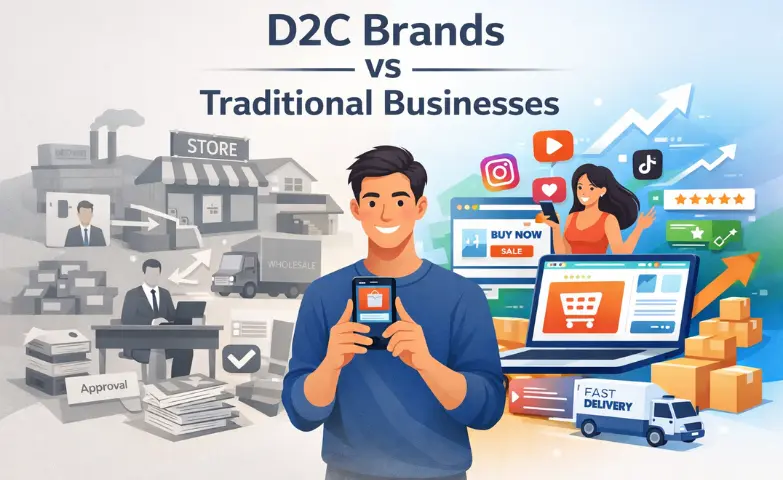
The consumption patterns of consumers have changed dramatically in recent years. Consumers no longer rely on local market places and retail chains to discover and buy new products. Instead they use their smartphones and purchase directly from brands with just a few taps. This suggests that the future in business lies in digitally empowered models.
D2C brands are not replacing traditional businesses. Instead they are reshaping how brands and consumers connect.
Many traditional businesses are now adopting hybrid models to stay relevant i.e., combining offline retail with D2C channels.
The D2C Business Model
D2C (Direct-to-Consumer) is a Business Model in which brands sell their products directly to customers without working with intermediaries like wholesalers, retail stores or distributors.
They prefer not to rely on retail stores or third-party sellers, instead these brands use their own websites, mobile apps, and social media platforms like Instagram or Facebook to market, sell, and distribute products.
Some renowned Indian Brands that function as a D2C business are Sugar Cosmetics, Lenskart, boAt, Mamaearth and Bewakoof.
Features that are Helping D2C Brands to Flourish
Direct and Strong Customer Relationship
Direct connection with consumers is the biggest advantage of D2C brands. Traditional businesses often lose customer data to retailers and distributors.
Features like Personalized communication or recommendations, direct feedback through reviews, emails, and social media allows D2C brands to improve products quickly and build strong brand loyalty. This is something traditional businesses struggle to achieve.
Lower Distribution Costs
Manufacturers, Distributors, Wholesalers, and Retailers are the multiple layers involved in Traditional businesses. Each layer takes their share of margin.
Most of these layers are eliminated by D2C brands. Which benefits them with Better profit margins, Competitive pricing for customers and extra control over supply chains.
With the saving amount they prefer investing more in marketing, innovation, and customer experience.
Digital-First Marketing
Traditional brands rely heavily on TV and print ads, whereas D2C brands use social media platforms like Instagram, YouTube, and TikTok to gain recognition.
They collaborate with Influencers and Creators which help them expand rapidly. This method involves measurable and flexible features.
Cycle of Product Launch
D2C brands can easily test products in small batches, iterate the designs based on real-time feedback and can quickly launch based on customer demand.
This flexibility allows D2C brands to stay ahead of trends and respond instantly to changing consumer preferences.
Due to complex approval and distribution processes, Traditional brands often take months or even years to launch new products.
Personalised Customer Experience
Personalisation is no longer an option. Nowadays customers seek for customized product recommendations, personalized emails and offers.
These experiences help D2C brands become customer’s preferred choice.
From discovery to post-purchase support, D2C brands control the entire customer journey, which helps them create seamless and memorable experiences that increase customer satisfaction and retention.
Traditional brands often fail to deliver this level of personalization at scale, due to restricted retail formats.
Storytelling and Community Building
Brand identity and strong storytelling is the utmost priority of D2C brands. Purpose driven branding helps them with engagement.
Transparency in sourcing and pricing helps them connect emotionally with customers, something traditional brands often lack due to mass-market positioning.
Social media plays the key role in fostering community engagement. Today’s consumers, especially Gen Z, avoid visiting stores and prefer digital channels for purchases.
Challenges Faced by D2C Brands
Challenges such as rising digital advertising costs, customer retention in competitive markets, logistics and returns management are often faced by D2C brands.
However their data driven approach and flexibility allows them to adapt faster than traditional businesses.
Perspectives of Top Entrepreneurs on The D2C Model
Entrepreneurs owning a successful D2C Model business often emphasise that owning it is not only about selling products through websites but more about owning the customer journey.
Veenita Singh, CEO of Sugar cosmetics highlights “Community Is the New Brand”.
She believes community building rather than mass advertising is the main reason why D2C brands grow faster.
Peyush Bansal, the co-founder of Lenskart says that “D2C Levels the Playing Field for Startups” as it eliminates the need for massive capital investment in retail from day one.
Based on product equality and customer experience startups can easily compete with established brands.
Nithin Kamath, the Co-founder of Zerodha shares that “D2C Brands Must Think Long-Term, Not Just Growth”.
He warns that aggressive scaling leads to failure and sustainable growth beats rapid expansion.
Conclusion
What’s your perspective on the increasing D2C Model Businesses? Share your views with ReciteYou and get a chance to be featured.