



Durgabai Vyam is a symbol of tradition and innovation. In the vibrant landscape of Indian art she started with painting mud walls in Barbaspur and she has also been honored with Padma Shri. Her work from the tribal heartlands of Madhya Pradesh to the national stage reflects her hard work of Gond art itself
The Art of Her Roots
Born in 1973 in a remote village of Mandla district of Madhya Pradesh. Durgabai Vyam belongs to the Pardhan Gond Community, which is known for its storytelling traditions and worship for nature. She started her artistic work from an early age of six. Her mother used to teach her the traditional Digna art. Digna art are the geometrical designs and patterns which are created on floors and walls during festivals and golden occasions.
If we uncover the history of Gond tradition, art is more than decoration, it is believed to be a language that expresses folklore and community’s relation with nature. Her grandmother used to make intricate paintings on their house mud walls and Durgabai used to be impressed by it. This sparked the love for Gond art which she carried with her through life.
What makes this background even more relevant is that, right from her childhood, Durgabai came into contact with an atmosphere in which there was no dichotomy between art and everyday life. These women in the family would consider themselves anything but artists in the conventional sense. This was an unbroken tradition which was passed down from generation to generation, not through textbooks or classes but through hands-on practice. Each festival saw the creation of new designs on walls and floors while each ceremony needed a visual language of its own.
Two Artists, One Vision
In 1996, Durgabai Vyam was invited to participate in the artistic workshop which was held at the Indira Gandhi Rashtriya Manav Sangrahalaya and this was one of the biggest events in her life as this workshop exposed her to a larger audience and brought her an opportunity to work on contemporary mediums like canvas and paper other than wall.
During that year, she got married to Subhash Vyam, a peer sculptor and artist. Both being in love with art, started exploring collaborative art forms, painting, merging sculptures and trying to push the boundaries of Gond art. While working together, Subhash brought a three-dimensional element to their projects, and through the use of visuals, Durgabai added complex storytelling. This became the hallmark of their collaboration projects and exhibitions.
This association is not simply limited to the use of the same studio space. Rather, this is one of those rare instances of an artistic exchange wherein two entirely different sensibilities share the same medium. Their collaborations have often been centered around issues of memory, migration, and the relationship between tribes and nature. Together, they produced the book Bhimayana, wherein they both wrote and illustrated the tale of Dr. B.R. Ambedkar using the Gond visual grammar, bringing their work right into the realm of caste-related politics and social issues. Bhimayana was widely lauded for its brilliant use of Gond art to communicate messages of great sociopolitical import.
Her Unique Style
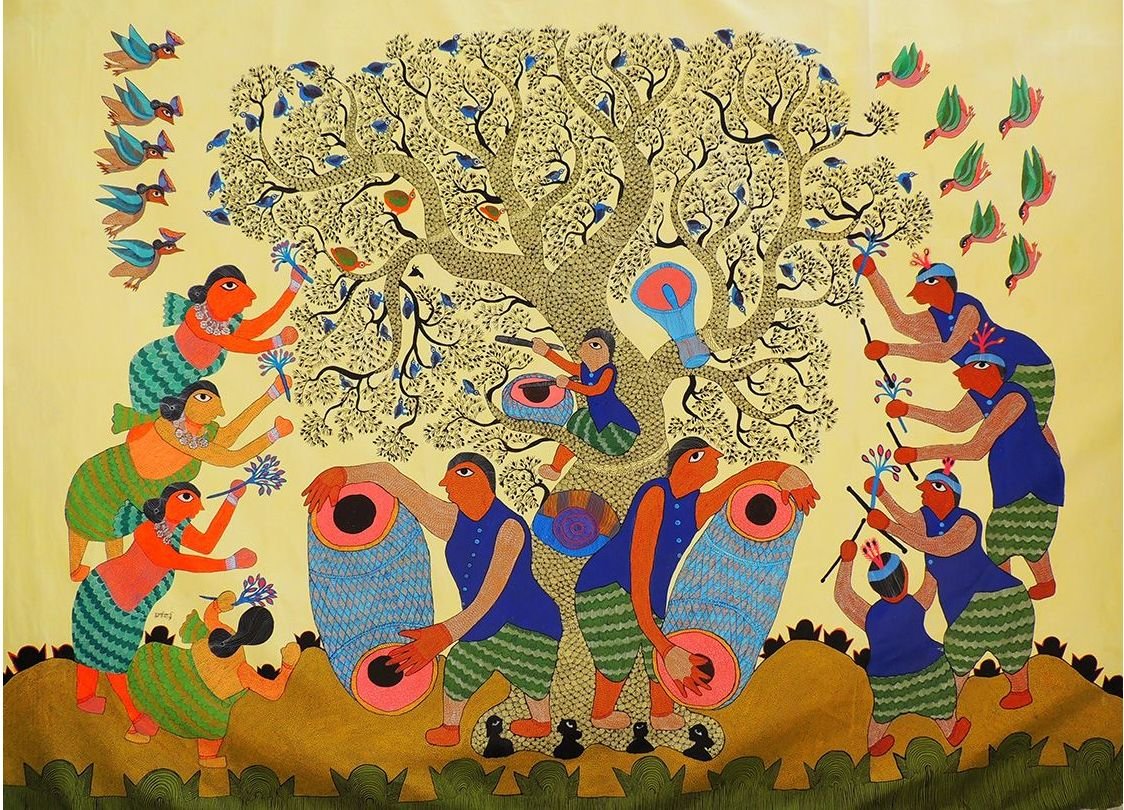
Use of vibrant colors, tangled lines and dot patterns which make up the beautiful image of flora, fauna, and daily village life is what defines Gond Art. What makes Durgabai’s work distinct is her ability to blend the essence of traditional Gond with bits of modernity, which makes them accessible and meaningful to present day audiences. Each painting of hers tells something unique. In her work Durgabai Vyam often uses symbols of animals, trees, gods, human beings, to depict social themes, environment concerns, personal stories and many more.
Her approach toward her paintings lies in a process that requires great attention and concentration. She constructs the painting with the help of small dots and fine lines forming larger figures and shapes. The trees seem to throb with their own life. Animals have a mythical presence. The people she draws do not represent individual identities but rather collective ones. The color scheme that she uses comprises deep terracotta reds, forest greens, vibrant yellows, and blacks. It is indicative of the natural landscape of Central India where she was born. In no way is the painting an imitation of nature, but rather it is the interpretation of nature as seen through her eyes and beliefs.
Beyond Borders
In the year 2022, the Indian Government bestowed on her the Padma Shri Award, which is one of the four most distinguished civilian awards that one can get in India. Winning such an accolade means more than being personally acclaimed because it means that tribal art, Gond art, has its own value in the rich artistic and cultural heritage of India. In fact, throughout the years, many pieces of her artwork were shown at reputable galleries in India and even other parts of the world. From Jehangir Art Gallery in Mumbai all the way to festivals in North America and Europe, her art was admired by people everywhere in the world.
The most astonishing thing about Durgabai Vyam’s international exposure is that she did not make any changes in her artistic language that would be able to appeal to the tastes of foreign audiences. Instead, everything she puts in every piece of her artwork comes from the Gond culture. What foreigners got to see is real Gond art, vibrant, alive and tied up with a certain landscape.
Read Also: Sunayana Malhotra: Crafting Art with Soul
The Stories Within the Paintings
Perhaps one of the most prominent features in all the paintings by Durgabai is how full they are of narratives. One painting could encompass all myths, seasonal festivities, and forest spirits along with some depictions from the routine lives of the people who lived in these villages. She has painted Mahua tree revered by the Gonds as a gigantic entity among birds and humans. Rivers have been portrayed as entities endowed with memory. Folk tales once told through music or speech have now been given the permanency of painting without losing their warmness in any way.
It seems that this very desire to depict the stories belongs to the tradition of the Pardhans who were regarded as the keepers of history in Gond society. Pardhans were known to be the singers who held in their memory the lineages and legends of their kings and great men. The act of painting for Durgabai is, therefore, an act of memory as well.
Art That Inspires
The success of Durgabai in creating her art helped her earn the fame in all India, and that motivated the new generation of artists belonging to tribal communities to come up with innovations based on their culture. It indicates that when art is done with passion and purpose, there are no limits.
Apart from serving as an inspiration to other artists, Durgabai has also made significant contributions to teaching art in her community. She has attended various seminars and workshops in order to teach her peers about the techniques as well as the cultural significance of Gond art. For those who belong to tribal communities and are trying to establish themselves as artists, the story of Durgabai has special importance.
The transition of Durgabai Vyam from the clay walls of her native Mandla village to the galleries of Mumbai and other places around the world does not only highlight the success she has achieved in life, but also demonstrates that artwork born out of communal values, interaction with nature, and decades of experience holds immense appeal for audiences around the world today. To put it differently, Vyam has brought Gond art to life in an inspiring way.
Comments are closed.